


Few questions have preoccupied academics and business leaders quite like the nature versus nurture debate. From psychology to philosophy, from musicianship to athleticism, researchers have long wrestled with whether our abilities are hardwired at birth or shaped by experience, environment and hard graft. In most fields, the answer has gradually become clear: nature matters, but nurture matters enormously.
Yet in business, one stereotype still persists. Entrepreneurs are often seen as people born with something special - instinctively risk-tolerant, visionary and wired differently from the rest of us. We look at figures such as Steve Jobs, Bill Gates or, closer to home, Sir Ian Wood, and conclude that what they achieved simply cannot be taught.
I have never fully accepted that view.
Having worked with businesses, universities and international industry networks across Scotland and internationally - including through WRIST and a range of entrepreneurial and innovation partnerships - I have seen repeatedly that entrepreneurial capability can be developed. Everything I have experienced over decades in business tells me that, in the main, entrepreneurs are made. And increasingly, we understand how to help create the right conditions for that to happen.
As someone who has spent much of my career building and growing businesses in highly competitive sectors, I also know that markets move quickly and competitive advantage never stands still. From a private sector perspective, the regions that succeed over the next decade will be those that create the best conditions for ambitious businesses to start, scale and compete internationally. Talent, investment and innovation are increasingly mobile. Regions cannot afford to stand still.
That belief was reinforced powerfully through my experience on the Massachusetts Institute of Technology’s flagship Entrepreneurship Development Programme in Boston and, more recently, through the work of Opportunity North East in bringing MIT educators directly to Aberdeen.
MIT is widely recognised as one of the world’s leading universities for innovation and venture creation, supported by a remarkable ecosystem including the Martin Trust Center, MIT delta v and an alumni network responsible for thousands of active companies across the globe.
At the heart of that success is something deceptively practical. MIT’s Disciplined Entrepreneurship approach breaks venture building into 24 structured, customer-focused steps. It treats entrepreneurship not as magic reserved for a gifted few, but as a discipline that can be taught, practised and improved.
The results are compelling. While globally only around 10% of start-ups survive long term, approximately 61% of companies emerging from MIT’s delta v programme are still operating or have been acquired within five years, collectively raising more than $1 billion in funding.
For the first time, this disciplined approach to venture building is now being delivered at scale in the north east of Scotland, with more than 100 entrepreneurs and business leaders participating in bootcamps and AI workshops led by Paul Cheek, serial technology entrepreneur and senior lecturer at MIT Sloan School of Management.
What makes this moment particularly significant is the scale of the AI opportunity now sitting in front of us. In addition to teaching the Disciplined Entrepreneurship framework, Paul focused on how founders can use AI to validate ideas faster, prototype more efficiently and scale businesses more effectively than any previous generation of entrepreneurs could have imagined.
By building AI Driven Enterprises - or AIDEs - businesses use AI as a core engine of growth, productivity and competitiveness.
This is more than creating start-ups. It is about founders building ambitious, internationally competitive businesses capable of scaling from the north east of Scotland.
The opportunity is to help founders scale faster internationally by combining entrepreneurial education, AI capability, global networks and commercial ambition.
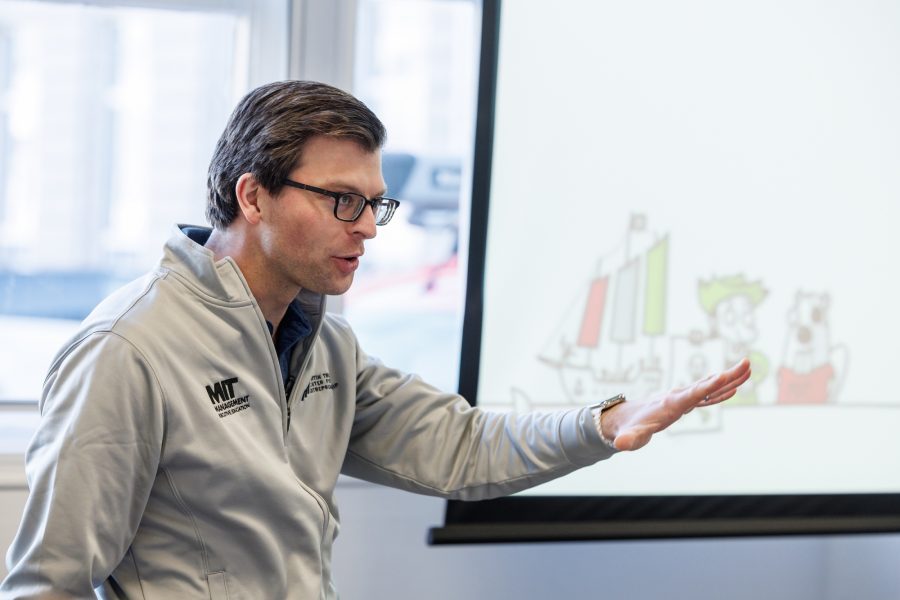
Speaking after the Aberdeen bootcamps, Paul Cheek said what surprised him most was the sheer curiosity of participants about what AI could do for their businesses, and the speed with which even sceptics began to recognise the opportunities it presents. Curiosity is not simply an innate gift. It grows through exposure, challenge and the right environment.
What gives me real confidence is that businesses, universities, investors, entrepreneurs and public sector partners across the north east are increasingly aligning around a shared ambition: building a globally competitive regional economy driven by innovation, entrepreneurship and growth.
Building the entrepreneurial ecosystem requires long-term collaboration between the private sector, founders, universities, investors and public sector partners to create the right conditions for innovation and venture growth to thrive.
That is precisely what Opportunity North East has been working to help create.
The north east of Scotland is already home to one of Scotland’s most dynamic high-growth digital technology clusters, with more than 300 businesses spanning agritech, clean tech, health tech and energy tech. For five years, ONE has supported entrepreneurs and partners to travel to MIT in Boston to learn from world-class educators and entrepreneurs. Now we are bringing that expertise directly into the region — widening access, accelerating ambition and embedding a more consistent approach to entrepreneurial education and venture scaling.
I know founders who attended these sessions are already actively applying the tools and techniques they learned as they grow and scale their businesses.
The nature versus nurture debate will no doubt continue in academic circles. But in the real world of building businesses, we have the evidence, the frameworks and the practical experience.
The regions that succeed economically over the next decade will be those that back ambitious founders early, help them scale globally and continue investing in innovation, entrepreneurial capability and AI adoption.
The north east of Scotland is well placed to be one of those regions.
This first ran in the Herald on 11.08.26

Follow Us


Opportunity North East Ltd
11 Queens Gardens
Aberdeen
AB15 4YD